
Beyond Links: Exploring Visual Representations of Multi-View Relations in Mixed Reality
Abstract
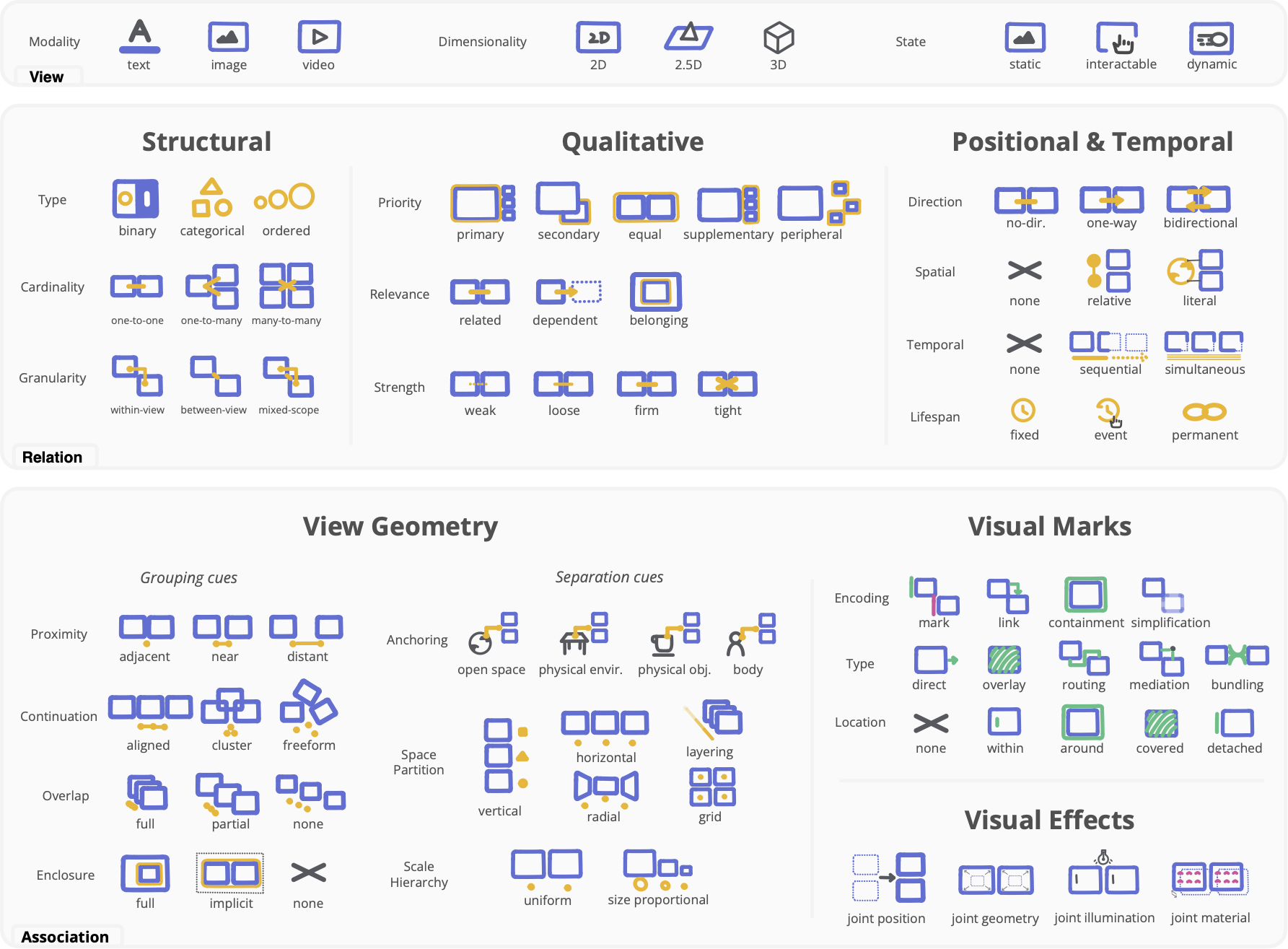
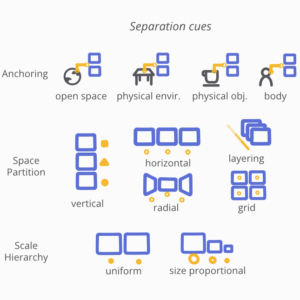
This paper investigates associations, explicit representations of relations between multiple views in Mixed Reality (MR). While research on 2D desktop environments offers extensive recommendations for communicating relations between multiple views, MR environments lack such systematic guidance, necessitating adapted solutions that consider their spatial affordances. To address this gap, we systematically explored association techniques in existing research. Building on established 2D multi-view literature and refining insights from prior design principles, we developed a codebook to describe view relations and their representations. Applying it to a corpus of 44 immersive multi-view approaches, we identified recurring design strategies and synthesized them into a design space of visual association techniques adapted for immersive contexts. Based on a lightweight prototyping framework, we validate the utility of the design space through three envisioning scenarios, demonstrating how associations can support exploration, coordination, and sensemaking in MR applications. Our results inform the design of MR multi-view environments.
Media: Videos and Supplemental Material
5-min Video Figure
10-min Recorded Talk
Design Space For View Association
Related Publication
@inproceedings{luo2026beyondlinks,
author = {Weizhou Luo and Rufat Rzayev and Benjamin Russig and Sivanon Visutarporn and Marc Satkowski and Stefan Gumhold and Raimund Dachselt},
title = {Beyond Links: Exploring Visual Representations of Multi-View Relations in Mixed Reality},
booktitle = {Proceedings of the 2026 CHI Conference on Human Factors in Computing Systems},
year = {2026},
month = {4},
isbn = {979-8-4007-2278-3/2026/04},
location = {Barcelona, Spain},
numpages = {19},
doi = {10.1145/3772318.3791398},
publisher = {Association for Computing Machinery (ACM)},
keywords = {Spatiality, content organization, Multiple Views, Multi-view relations, Mixed Reality}
}Weitere Materialien
@inproceedings{luo2022arsensemaking,
author = {Weizhou Luo and Anke Lehmann and Hjalmar Widengren and Raimund Dachselt},
title = {Where Should We Put It? Layout and Placement Strategies of Documents in Augmented Reality for Collaborative Sensemaking},
booktitle = {Proceedings of the 2022 CHI Conference on Human Factors in Computing Systems},
series = {CHI '22},
year = {2022},
month = {4},
location = {New Orleans, LA, USA},
numpages = {16},
doi = {10.1145/3491102.3501946},
publisher = {ACM},
address = {New York, NY, USA},
keywords = {spatiality, spatial layout, content organization, sensemaking, affordance, qualitative user study, Augmented Reality, Mixed Reality, collaborative sensemaking}
}Weitere Materialien
Acknowledgments
This work was funded by the German Research Foundation (DFG, Deutsche Forschungsgemeinschaft) as part of Germany’s Excellence Strategy – EXC 2050/2 – Project ID 390696704 – Cluster of Excellence “Centre for Tactile Internet with Human-in-the-Loop” (CeTI) of Technische Universität Dresden, DFG grant 389792660 as part of TRR 248 (see \url{https://perspicuous-computing.science}), the German Federal Ministry of Research, Technology and Space (BMFTR, SCADS22B) and the Saxon State Ministry for Science, Culture and Tourism (SMWK) by funding the competence center for Big Data and AI “ScaDS.AI Dresden/Leipzig“, and by the BMFTR in the program of “Souverän. Digital. Vernetzt.”. Joint project 6G-life, project identification numbers: 16KISK001K & 16KIS2413K.